Rethinking Wind Energy: Digital Excellence for a Secure Future

Rotor blades are among the key components of every wind turbine and are particularly susceptible to damage, yet to this day they are not equipped with sensors or electronics.
This is where QI-Digital comes in, focusing on digital remote inspection to make the operation of these giants—which can be up to 100 meters long—smarter, faster, and safer.
In the KI-VISIR project, the Federal Institute for Materials Research and Testing (PTB), together with innovative partners, is combining state-of-the-art AI-based image analysis with high-quality real-world measurement data. The result: a public reference dataset that is unique worldwide. It demonstrates how digital quality infrastructure is setting new standards in the wind energy industry for greater efficiency, fewer downtimes, and a longer service life for the turbines.
What makes this special is that the dataset is freely available and accessible to everyone. This benefits wind farm operators, maintenance companies, and technology developers alike and the entire industry gains transparency, trust, and future security.
Contact: Dr. Michael Stamm (Thermographic Methods, BAM), Phone +49 30 8104-3884
Press Conference on the Efficient Inspection of Rotor Blades Using Thermography and AI


At WindEnergy Hamburg, the Federal Institute for Materials Research and Testing (BAM), in collaboration with the AI startup LATODA and Romotioncam, presented groundbreaking developments in rotor blade monitoring — another milestone in the QI-Digital Wind Power Use Case. At the heart of the project is the combination of passive thermography, AI-supported image analysis, and ground-based visual inspections. The goal is to significantly increase the efficiency, safety, and service life of wind turbines—through early damage detection, optimized maintenance processes, and minimal downtime.
Click here for the LinkedIn post.
WindEurope Technology Workshop 2025


At the AI4Blades Challenge during the WindEurope Technology Workshop 2025 in Istanbul, international teams used QI-Digital’s AI-VISIR dataset to develop new AI approaches for rotor blade quality assurance. Led by Dr. Michael Stamm (BAM), Jonathan Sterckx’s team impressed the jury with their fusion of thermal and visual image data—an important step toward intelligent wind turbine inspections. The award ceremony, hosted by Giles Dickson (WindEurope), served as the grand finale of an inspiring event.
Click here for the LinkedIn post. Click here for the video.
Ground-Based Thermography in Operation: RomoTherm
In the follow-up project RomoTherm, BAM is working with RomotionCam™ to further develop thermographic external inspections of rotor blades. To this end, a thermal imaging camera is being integrated into RomotionCam’s existing inspection system, which already captures high-resolution visual images of rotating rotor blades.
The method uses passive thermography: Temperature differences on the rotor blade surface reveal structural features and near-surface damage without directly interfering with the turbine’s operation. By simultaneously capturing visual and thermographic data throughout the entire rotation of the rotor blade, it becomes easier to distinguish between interference factors—such as reflections—and actual damage.
RomoTherm builds on the predecessor project KI-VISIR, which has already produced an open reference dataset consisting of thermographic and visual inspection images. The project, part of QI-Digital, also highlights the importance of high-quality reference data for a digital quality infrastructure. After all, only standardized and trustworthy data can provide the foundation for reliably training and validating AI-based inspection methods and making them suitable for industrial use.
Thermographic Inspection from the Inside: InInspekt

Much of the damage to modern wind turbines occurs inside the rotor blades and goes undetected for a long time. Traditional inspection methods are increasingly reaching their limits. They are time-consuming, often labor-intensive, and difficult to scale.
This is where the InInspekt project comes in. Together with LATODA, EduArt Robotics, and the University of Würzburg, BAM is developing a robot that inspects rotor blades from the inside using thermographic, visual, and geometric methods. An onboard heat source enables controlled active heating regardless of weather conditions or time of day. In this way, InInspekt specifically targets those internal structural defects that remain inaccessible to passive external thermography. The long-term goal is to have AI-based analysis algorithms directly on the robot identify suspicious areas, which are then characterized during a second pass using active thermography.
Standardized procedures—such as a consistent perspective, consistent sensor configuration, and a consistent data foundation—make inspections more reproducible and reliable. Quality thus becomes measurable and more objective, directly contributing to the core concept of the QI-Digital initiative: moving away from error-prone, document-based inspection processes toward data-driven, networked, and scalable quality assurance systems.
Click here for the LinkedIn post. Click here for the InInspekt article: Autonomous AI Robots for the Internal Inspection of Rotor Blades.
Impressions from Norway
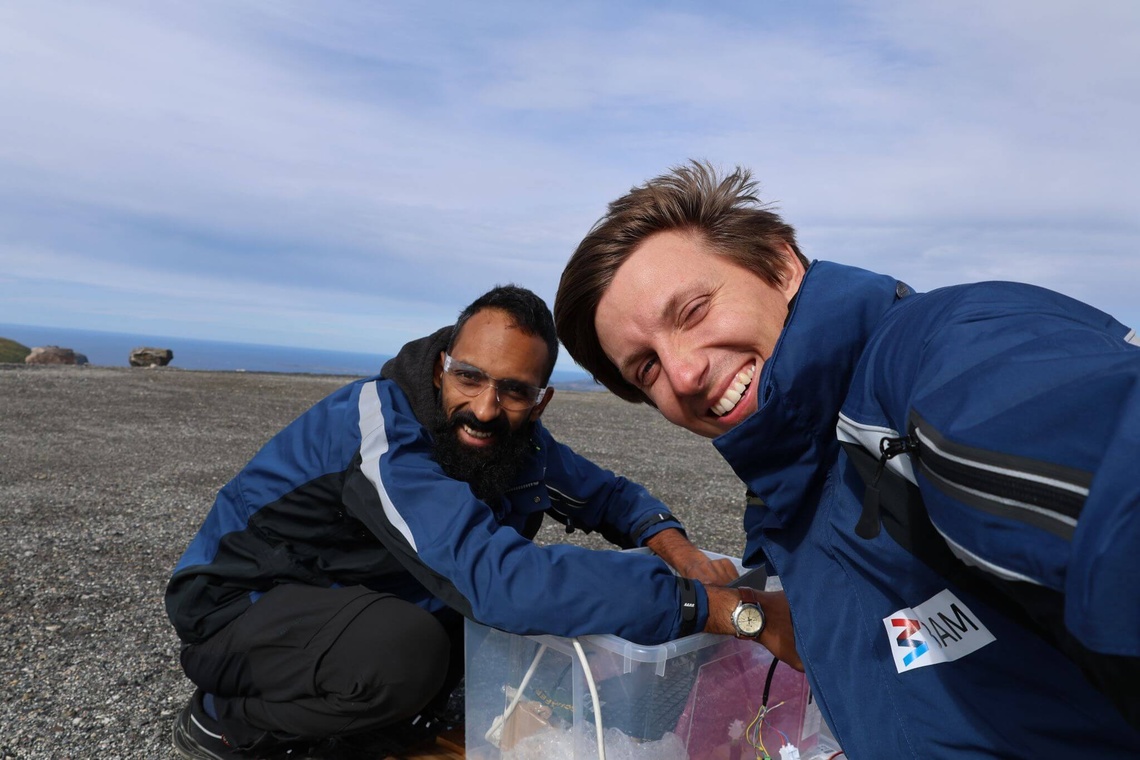


Our colleagues (BAM 8.3 – Thermographic Methods) conducted measurements in Norway to create a dataset for training AI image analysis. The measurement data obtained in this process forms the basis for reliable AI-supported image recognition—and impressively demonstrates that the QI value chain begins with the physical measurements themselves.
Click here for the LinkedIn post.